
Using a modified Canon 30D DSLR (purchased off eBay) Professor Charles M. Falco has been able to reveal underlayers of existing artwork showing details previously unknown about the artwork.
The technique of using infrared (IR) to examine old artwork is certainly not new, but Professor Falco’s camera mod allows pretty much anyone, with or without specialized skills, to do the initial testing.
Charles Falco, Professor of Optical Sciences, did a simple mod on the Canon 30D to remove the IR blocking filter that is standard on current DLSRs, and replace it with a visible light blocking filter. (This is what many IR photo enthusiasts do themselves) He then adjusted the Auto-focus and Auto-exposure systems to work with the new setup.
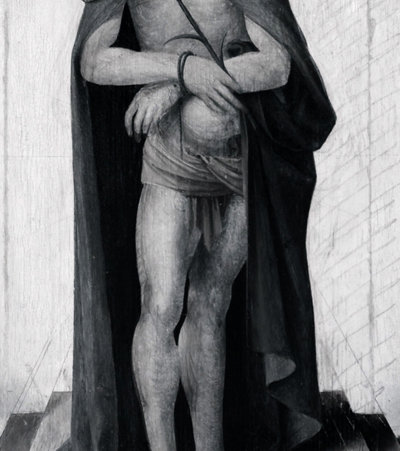
“The lines in this underdrawing show up in a detail of a Renaissance painting titled “Man of Sorrows with Saints and Donors.” The lines apparent in the infrared converge to a well-defined vanishing point, showing that this particular artist understood the laws of geometrical perspective. (Credit: Charles Falco)”
This is all known technique. What Professor Falco gets credit for, as far as I can see, is having the credentials (read: an academia union card) to make curators of museum collections aware that it can be done without an official museum undertaking. Previously, such work would require all the permissions and insurances to send an artwork to a lab equipped with expensive hardware to do the (mostly) same thing. Now an underpaid grad student can be pressed into service!
An interview podcast with Professor Falco can be heard on KJZZ (NPR Phoenix)
There is also a piece in the UANews, Scientist’s Camera Sees Artwork Down to Its Underdrawings, on the Professor’s efforts.

Not to be snarky, but Charles! You’re a respected Professor of Optical Sciences, a life long photographer. Get a better portrait of yourself! This one is soft, shaky, out of focus and has poor color fidelity. Turn that camera on yourself, and hold still!
Or, get in touch with me for a sympathetic professional portrait. I’m only a few miles away from you 😉
But, thanks for doing the camera modification work.
I’ve been working with digital IR, and what I’ve discovered will be revealed in a later set of posts on PhotographyUncapped. Cheers.
I heard this story on NPR. I think he said there was a 5% chance of discovering hidden treasures, but I don’t know where he got that statistic from. I found you – you’re a hidden treasure…..
Gee. thanks, ducky. Back to you too.
But don’t point that thing at me lessun you’re gonna use it!
KEN!!!! I miss you!!! They’re making me do digital! Well I guess that’s not so bad, but I really really really miss doing film. 🙁 When I graduate from NAU (hopefully May 2011) I fully plan on taking studio black and white with you!
<3,
Erin
P.S.
I hate living in snow!
MUAH!!!
Hey Erin, You’re always welcome in our classes. If you don’t freeze, come on down and get back into film, or, possibly do a mix of digital and film. Possibilities – endless!
An awesome story Ken, thanx for posting! I thought about removing the ir filter on my old dlsr, but made a charitable donation to an assistant in need instead. I’ll have to get on it in the future. I found alot of instructional pages on the web, like this one… Canon Digital Rebel (300D) Modification , for those interested in ir filter removal. Also, Bill, in the repair department at Tempe Camera will do the modification for those who are less inclined for the DIY method.
ps- it’s been a while Ken, I’ll have to swing by SCC and say hello one of these days.
Hey Andrew, long time…
I didn’t know that there was a local tech doing the work. Thanks.
From my reading, getting the IR filter off is one step,
but if you want accurate focus (and who wouldn’t)
you have to replace the IR filter with and identical thickness of optical glass.
Cheers,
Ken
I really liked this interview and have done some infrared photography my self. I wanted to add to the discussion that you do not have to risk your own camera to make it a infrared only camera. If you have some extra cash you can buy one. I bought mine from ebay. It is a Canon Rebel Xsi. It is amazing and I am going to experiment with it at a local museum. Thank you for the interview and information
Hi Elisha,
Great that you have a pre-modded camera!
Are you using any filters with it?
Ken
Hi Ken, The internal filter is a Enhanced Color IR
(equivalent to 665nm)from Life Pixal. This is really wonderful because I can have some great color to my photos and then I can always convert them to black and white afterward. On the lens I tend to keep a circular polarizer on. I haven’t experimented much with the external filters yet. I haven’t found much of a need to do so.
Thanks for the info, Elisha.
Sounds like a good rig.
Ken
Nice and indeed a very informative post. I do work in windshield and auto glass industry and its very difficult to find some latest happenings in this industry. Thanks for writing such a good post and keep up the good writing. Thank You